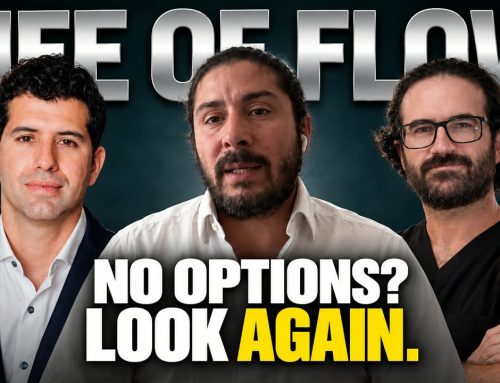
We built better stents, wires, and balloons—then kept sending fistulas back into the same chair-side injury loop.
Dr. Aaron Moore is a Jacksonville vascular surgeon who spent about 15 years in Navy/military medicine before choosing private-practice independence. In Jacksonville he became a high-volume dialysis access operator—roughly two to three hundred fistulas and grafts a year—and watched repaired access return from the unit damaged again. When an interventional radiology colleague showed him an early mapping concept years before this recording, he moved from intrigued investor to operator and VP of clinical affairs. He names the product Veristra: dialysis management software for the cannulation chair.
The stakes are irreversible for patients living on access. Upstream craft can be exquisite, then vanish into what Moore calls the dialysis-unit black hole: create the fistula, lose continuous history chair-side, injure it through repeat same-area puncture, rescue it with more devices, and send it back into the same mechanism. He reframes the residency joke that dialysis “cuts with an ax.” Chair-side staff work under time pressure—often about 12–15 minutes from door to machine—with variable clinical background, heavy OJT, and turnover he cites as high as ~35% in some literature. Without a map, patients become the memory, and area puncture wins because it is fast and familiar.
In this conversation, Dr. Aaron Moore reveals:
⬛ Why “surgeon creates → unit black hole → repair → repeat” is the core failure loop
⬛ How area puncture becomes default while rope-ladder remains proven and under-implemented
⬛ What changes when arterial and venous sticks are photographed, scaled, color-aged, and heat-mapped
⬛ Why recording cannulation points without showing history still leaves staff flying blind
⬛ How hazard markers preserve pain, twists, and “avoid here” knowledge that turnover erases
⬛ Why preventing pseudoaneurysms at the point of care beats only predicting referral timing
⬛ How low the field set the bar when ~50% annual fistula patency can pass as acceptable
The Dialysis Unit Is a Black Hole: Why Fistulas Keep Failing | Aaron Moore
Timestamps:
00:00 The dialysis access black hole
00:45 Life of Flow intro
00:59 Welcome back: entrepreneurship, not war stories
01:47 Navy medicine to Jacksonville independence
05:02 Owning dialysis access in private practice
05:34 Micrometer surgery, missing chair-side tools
09:31 Same cannulation paradigm since 1965
09:55 Why the dialysis unit feels like a black hole
10:31 Overbuilt rescue tech, underbuilt point of care
12:29 Area puncture vs rope-ladder reality
13:44 Photograph, QR scale, mark every stick
15:25 Heat maps that show where you’ve been
18:26 From curious investor to operator
25:24 Pilot lesson: recording without history is still blind
32:33 Stop predicting pseudoaneurysms—prevent the pattern
34:22 A 50% annual fistula patency bar
37:28 The 1973 engineer who mapped every poke
50:04 Pilot size, clustering trend, what to prove next
Follow the guest:
LinkedIn: [https://www.linkedin.com/in/vascularmdjax](https://www.linkedin.com/in/vascularmdjax)
In-episode product: Veristra access mapping, hazard notes, heat maps, and LADX/LADDEX stick-dispersion score
Origin thread: IR colleague concept; company ~2022; Moore VP of clinical affairs
Resources mentioned:
Area puncture vs rope-ladder technique (conceptual literature discussion; no single citation titled on-air)
Guest-stated CMS context: more than 500,000 U.S. patients dialyzing; ~70–80% needing annual access intervention; cost band about $18,000–$35,000
FDA breakthrough device designation and roughly year-long FDA process as narrated
1973 congressional dialysis reimbursement fight; patient-engineer who plotted every access point on graph paper
Value-based/capitated dialysis economics as a reason access maintenance spend matters
Pilot arms: history-visible vs record-only; multi-center ambitions discussed
Watch the black-hole diagnosis, the heat-map workflow, and the closing honesty check: behavior change only matters if intervention burden and patient time in rescue mode actually fall.
Life of Flow is hosted by Dr. Lucas Ferrer & Dr. Miguel Montero-Baker.
🌐 Website: [https://lifeofflowpodcast.com](https://lifeofflowpodcast.com/)
▶ YouTube: [https://www.youtube.com/@LifeofFlowPodcast](https://www.youtube.com/@LifeofFlowPodcast)
🎧 Listen: Spotify [https://open.spotify.com/show/5GMv47SJ0ePxbjtIb1GZ5U](https://open.spotify.com/show/5GMv47SJ0ePxbjtIb1GZ5U) · Apple [https://podcasts.apple.com/us/podcast/life-of-flow/id1705596604](https://podcasts.apple.com/us/podcast/life-of-flow/id1705596604)
📩 Partner with the show: info@lifeofflowpodcast.com
Connect with the hosts:
Prepared for Life of Flow publication. Educational discussion only; not individualized medical advice. The core question is whether better chair-side memory can reduce